It begins when a person accepts that they do not have time to be aware. There is a moment that precedes every successful social engineering attack. It is not the moment when the message arrives. It is not the moment when the link is opened. It is not even the moment when someone enters a password, approves a request, scans a QR code or believes a voice that sounds familiar.
That moment comes earlier.
It begins when a person, under the pressure of speed, role and expectation, stops checking their own decision. That is where modern social engineering truly begins.
Not in the inbox. Not on the phone. Not in a fake portal. Not in a deepfake call. Those are merely channels. The real attack takes place in the space between impulse and awareness, in the brief gap where a person no longer asks, “What is really happening here?”, but only, “What do I need to do?”
That is why it is outdated to say that social engineering attacks human naivety. That formulation is too easy. It creates a comfortable distinction between those who “fall for it” and those who believe they know better. In 2026, that distinction is no longer reliable.
Today, you do not need to be uninformed to be deceived. It is enough to be tired. It is enough to be in the middle of a working day in which everything is measured by urgency. It is enough for the request to arrive through a channel you already use, in a tone you recognise, within a context that resembles your everyday routine.
The attacker no longer has to look like an attacker.
It is enough for the attacker to look like a process.
From Deception to Routine
Traditional social engineering tried to convince a person of a lie. Modern social engineering tries to blend into routine so effectively that the lie is not even noticed as a separate event.
The request arrives as a task. As an internal check. As a message from support. As an urgent access change. As an identity confirmation. As a conversation we do not want to complicate. As something familiar enough not to be treated as a risk.
That is its power.
The most dangerous attacks today do not create panic. They create recognition.
“This looks like something I do all the time.”
“This sounds like my team.”
“This is probably just another urgent thing.”
“I can finish this in a minute.”
And in that “minute”, security often disappears.
People most often do not fail where they do not know. They fail where they think they already know. When something looks like routine, the brain saves energy. It does not analyse every detail. It does not open every request as a new situation. It recognises a pattern and moves into execution.
The attacker is counting precisely on that.
AI Has Not Only Accelerated the Attack. It Has Made It More Precise
Artificial intelligence has changed social engineering, but not only because it can write a more convincing phishing email. That is merely the surface of the problem.
The deeper problem is that AI enables the attacker to personalise pressure. The message no longer has to be generic, grammatically poor or obviously strange. It can be precise. It can match the role, language, project, organisational context and moment in which the target is most likely to be available.
Research on automated spear phishing has shown that AI-generated, personalised attacks can achieve the performance of human experts, while significantly reducing cost and enabling expansion across a large number of targets. In other words, what once required time, skill and manual effort is now becoming industrially scalable.
But the most important point is not that AI writes better.
The most important point is that AI helps the attacker find the point at which a person stops checking most quickly.
Some people respond to authority. Some to urgency. Some to fear of making a mistake. Some to the desire to help. Some to the need to appear professional. Some to a message that feels like the continuation of an existing conversation.
Modern social engineering does not target only data.
It targets the state in which a person makes a decision.

The Problem Is Not the Human. The Problem Is the Architecture of Pressure
In cyber security, the phrase “the human is the weakest link” has been repeated for too long.
That phrase is worn out. More importantly, it is often inaccurate.
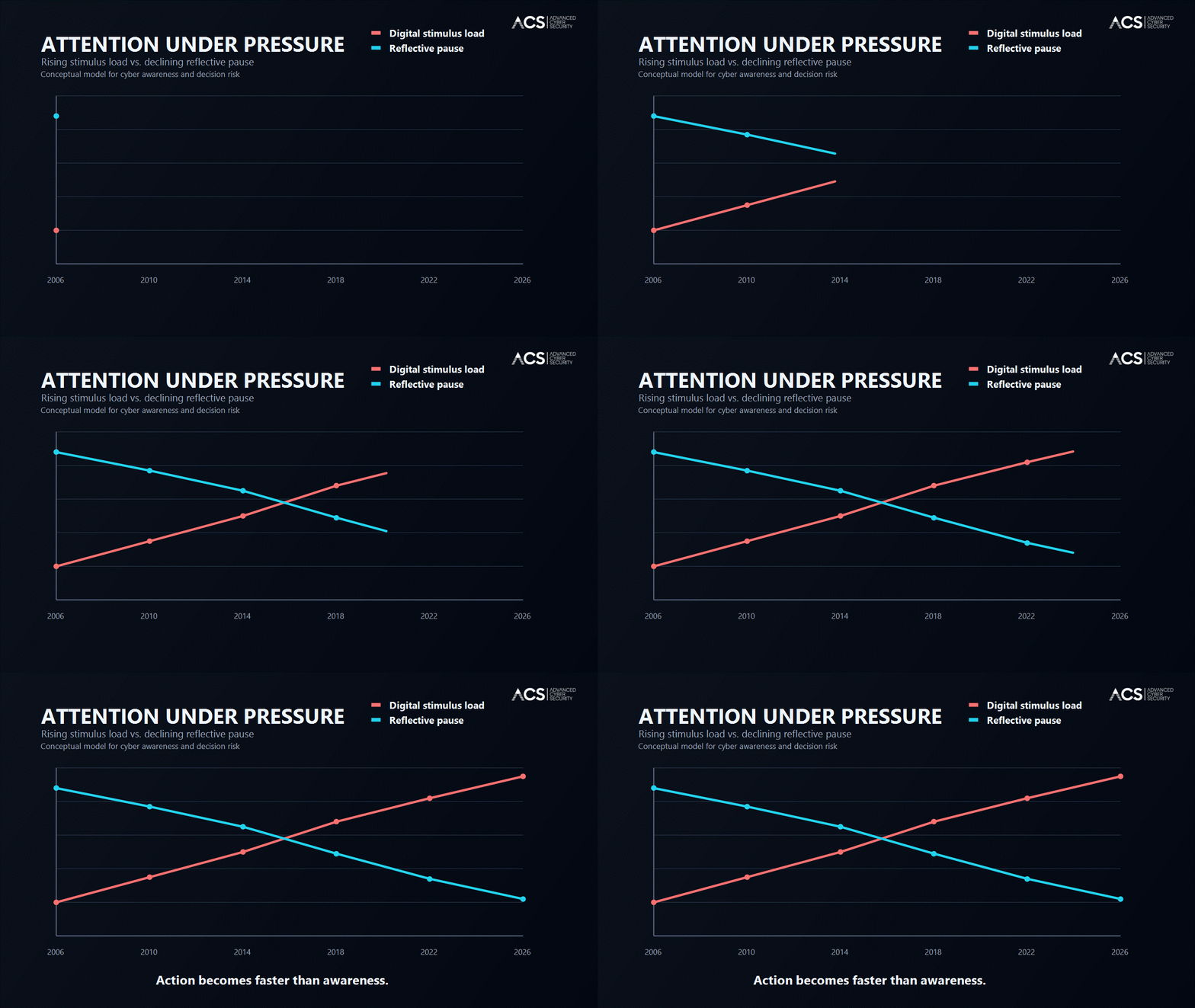
The human being is not the problem in itself. The problem is a human being left alone in an environment that trains them every day to be fast, available, compliant and operational.
If an organisation constantly asks employees to respond immediately, move from tool to tool, approve requests on the go, remain available across multiple channels and avoid “slowing down the process”, then it cannot simultaneously expect every individual to spontaneously become a calm risk analyst in a critical moment.
You cannot seriously defend a person if, organisationally, you teach them not to pause.
Social engineering exploits exactly that conflict. It does not attack only the individual. It attacks a culture in which doubt is perceived as an obstacle to productivity.
“Check once more” sounds slow.
“Confirm through another channel” seems unnecessary.
“Wait two minutes” looks like a luxury.
“I will not approve this until I understand it” sounds like resistance.
And yet those two minutes often make the difference between an incident and a prevented incident.
An Attack on the Role, Not Only on the Person
In 2026, social engineering increasingly attacks the professional role a person carries.
A finance employee does not want to block a payment. An administrator wants to resolve access. HR wants to help a candidate. A manager wants to remain available. An engineer wants to fix a problem. An employee does not want to appear paranoid in front of colleagues or superiors.
The attacker is not only asking, “How do I deceive this person?”
The attacker is asking, “Which version of themselves will this person try to perform in this moment?”
This is where social engineering becomes a serious sociotechnical problem. It does not target only passwords, tokens, accounts or money. It targets role identity: the need to be useful, fast, responsible, polite, efficient and aligned with the expectations of the system.
That is why a successful attack often does not feel like external pressure.
It feels like an invitation to be what the organisation already expects us to be.
Why Traditional Training Is Not Enough
Security awareness training remains important, but it is not sufficient on its own.
Large studies on anti-phishing training show that standard training programmes often do not have a significant impact on real click rates or reporting rates. This does not mean that people should not be educated. It means that education based solely on recognising “suspicious signs” does not solve the problem when attacks increasingly stop looking suspicious.
If users are told to “pay attention”, while simultaneously working in an environment that systematically drains their attention, the message is contradictory. If they are told “do not rush”, while processes reward speed, the message is weak. If they are told “verify”, while the culture treats verification as mistrust, the user will often choose the more socially acceptable behaviour in a critical moment: not to complicate things. That is why serious defence against social engineering does not begin only with new training. It begins with changing the conditions in which decisions are made.
Organisations must protect the employee’s right to pause. Verification must be part of the process, not an exception. Refusing an unusual request must not be uncomfortable; it must be expected professional behaviour. Confirmation through a second channel must not look like paranoia; it must be the standard. Without that, the human remains the last line of defence in a system that gives them no space to defend.
New Cyber Literacy: Recognising Yourself Before Recognising the Deception
The next phase of cyber literacy will not be only the ability to recognise a fake message. It will be the ability to recognise the state in which we become available to deception. That is an important distinction.
- The question is no longer only, “Is this link safe?” The question is, “Why do I want to open it immediately?”
- It is not only, “Does this person really exist?” It is, “Why do I feel uncomfortable verifying this?”
- It is not only, “Is this request legitimate?” It is, “Am I acting because I understand, or because I want to remove the pressure?”
These are not philosophical questions. These are operational security questions.
Because today, the attacker does not always need to break into the system. It is enough to find the moment when a person bypasses their own verification mechanism. That is precisely why defence must move beyond mere warning and towards awareness, process and culture.
Technology remains essential: MFA, detection, monitoring, filtering, identity protection, segmentation and access control. But none of these measures removes the need for a person, in a critical moment, to have the right, knowledge and organisational support to say: “I am stopping. I am checking.”
That is not slowing the business down. That is business maturity.
Conclusion
The most dangerous social engineering attack does not begin with a message. It begins when we confuse speed with competence. When we confuse availability with responsibility. When we confuse routine with security. When professionalism begins to mean reacting before understanding.
In 2026, social engineering is no longer only a technique of deception. It is a discipline of exploiting human automaticity in systems that have become too fast for their own attention. That is why serious defence does not begin with the question, “Is this fake?” It begins with a deeper, harder and more useful question:
In what state am I making this decision?
Because perhaps the greatest risk is not that attackers know more and more about us. Perhaps the greater risk is that, in the decisive moment, we know too little about ourselves.

Note: This text draws on current research and reports in the fields of social engineering, AI-enabled spear phishing and security culture, including the Verizon DBIR 2026, research on automated spear phishing and studies on the effects of anti-phishing training.
Originally published by Advanced Cyber Security on LinkedIn, 8 July 2026. Read this article on LinkedIn ↗.